The CMO Clarity Framework: A Marketing Transformation Framework for Enterprises Under Pressure
This is a test excerpt with content in it to verify the field saves
Salesforce launched Agentforce in 2024 to unify its enterprise AI capabilities into a single operational layer. Built on Einstein AI, Agentforce moves beyond assistive predictions, enabling agents to reason through decisions and execute across end-to-end enterprise workflows.
As a new platform in the AI landscape, Agentforce is still defining how it performs in real production environments. Since 2024, Bluprintx has delivered many Agentforce deployments, giving our teams early, hands-on insight into how the platform behaves at scale.
What we’ve learned from teams entering production is consistent. Agentforce delivers its earliest wins by removing friction from high-volume, rules-driven work, and by deflecting support load through fast knowledge retrieval and intelligent case triage. In practice, success depends less on the agent itself than on how clearly the work has been designed for the agent to perform.
Agentforce is Salesforce’s platform for creating autonomous AI agents capable of executing actions on Salesforce systems and acting on behalf of humans when confidence dips. At a fundamental level, it is a decision layer meant for work in real business workflows.
Teams build on our experience around Agentforce implementations, where they find, during high-volume, rule-driven work, that Agentforce makes friction-free. Some common examples include patient engagement workflows that work for intake and follow-ups or support deflection from knowledge lookup and case triage. In each case, success depends less on the agent itself than on how plainly the work has been designed for it to be successful.
It is true that Agentforce builds on Einstein. Agentforce marks a structural change in the way AI works inside Salesforce. Architecturally, Agentforce adds an important layer of true reasoning. Einstein was assistive, providing predictions and suggestions. Agentforce implements the Atlas Reasoning Engine, which allows agents to plan steps, take actions, and confirm results.
At a high level, Agentforce combines configuration, data, and reasoning to make decisions and take action inside Salesforce.
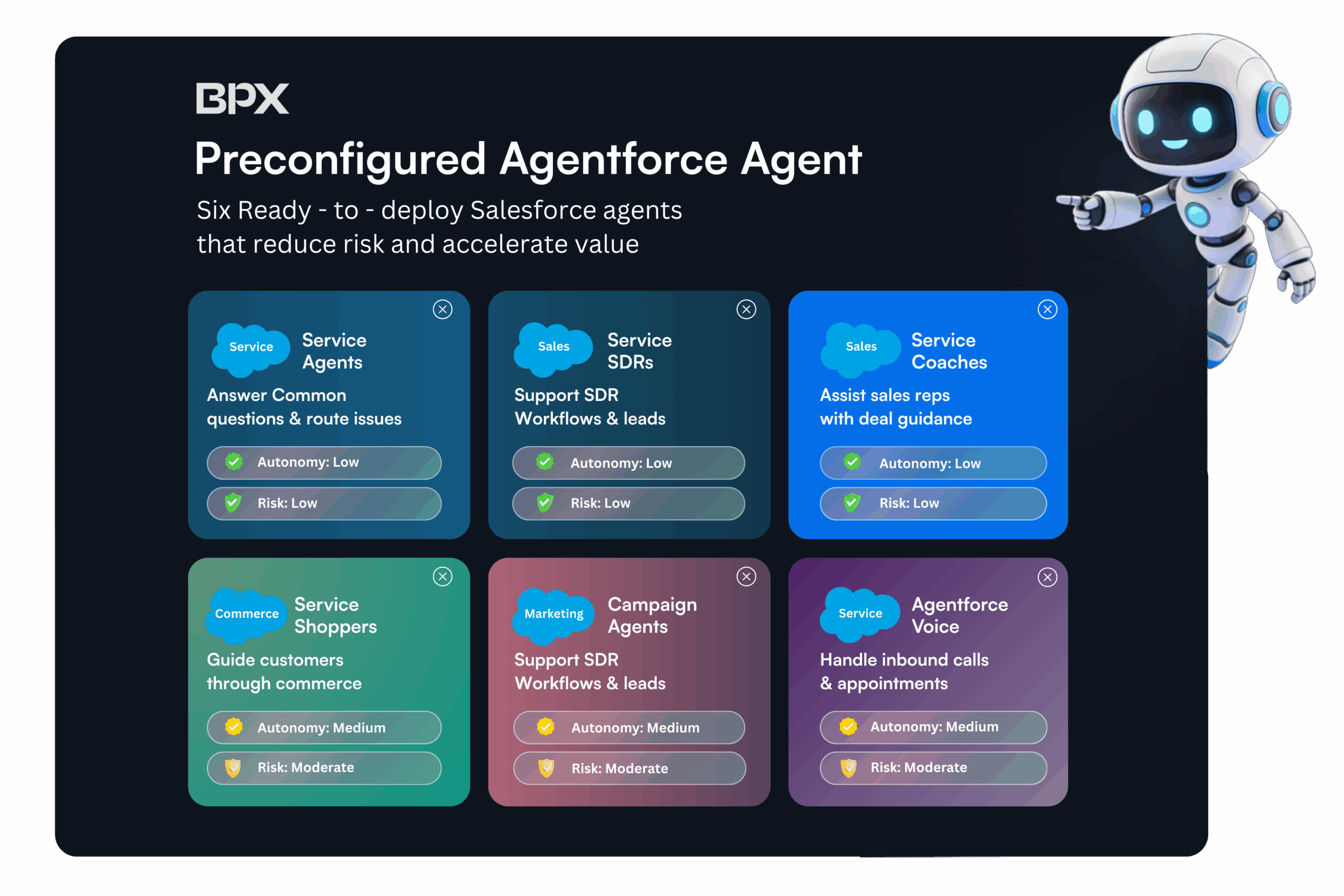
A preconfigured Agentforce agent is an out-of-the-box agent template created by Salesforce to facilitate standard enterprise tasks.
Their benefit is not that they are “plug and play,” but that they are production-oriented by default.
Every Preconfigured Agent:
In fact, successful teams treat preconfigured agents as the first layer and not as the final answer. They are usually deployed internally first, see the changes in real business processes, and then iterate as data and processes are validated. With automation, the spread continues on trusted foundations.
Preconfigured agents should be tailored to an organization. They minimize the set-up time and establish known patterns, but their effectiveness does still depend on the definer of goals, processes, and guardrails that are defined prior to production.
Once agents enter production, the more fundamental design question arises: What to do with the behavior of the agents? Are they to be deterministic or non-deterministic?
Deterministic systems behave the same way every time, such that the same inputs always yield the same consequences. In the case of non-deterministic (probabilistic) systems, variability is added, and outcomes are assessed based on likelihoods as well as confidence scores. Regulatory exposure, reputational risk, and mission-critical outcomes all call for a careful choice for this process.
Agents in industries such as health and social impact are typically programmed to work in deterministic ways. It means the same inputs will always lead to the same outputs. Deterministic behavior facilitates auditability, compliance, and trust and resolves ambiguity problems with tightly controlled or sensitive processes.
Agents sometimes require deterministic workflows and have no absolute decision-making ability. A great example of this is BPX’s work with AVPN. Agents consume information and format recommendations, but decisions ultimately belong to human stakeholders. They have transparency and accountability but reduce manual effort.
At the enterprise level, Agentforce is not about replacing people. It changes how scale works. Organizations can carry more volume, serve more markets, and support more complexity and without building headcount at the same rate.
Automation Without Proportional Headcount Growth: Agentforce performs repetitive, high-volume requirements that drive hiring as demand increases. If agents own well-defined parts of workflows, it can relieve growth pressure for human teams to focus on their other work.
Scaling Service, Support, and Engagement Globally: With agents working with centralized data and standardized processes and workflows, they scale more consistently than human-focused teams. It allows for growth in all time zones and geo areas without compromising service performance or operational visibility.
The success of Agentic AI won’t depend solely on the performance of the model. In the enterprise, systems like Agentforce are a success, or failure, based on fundamentals that do not hinge on hype but execution.
The takeaway is straightforward. Agentic AI is only transformational if it is considered as an integral part of the business, rather than as something you bolt on to it.
Ready to move from Agentforce adoption to production?