



Every year, CNX26 sets the tone for where Salesforce's marketing platform is heading. This year felt different, not because of a dramatic reinvention, but because of what the announcements said about where the industry actually is.
As part of the Marketing Cloud Partner Advisory Board, one of just 12 global partners invited to spend the day before the conference with Salesforce's product leadership team, I had the advantage of context before the keynote stage. That context changed how I interpreted everything that followed.
> TL;DR: Salesforce has moved well beyond experimentation. The bigger challenge for most organisations is turning AI marketing capability into operational reality.
Key takeaways before we get into the detail:
The Platform Has Matured. The Industry Is Catching Up.
The framing that stuck with me from CNX26 was not a single product announcement. It was a slide showing more than 250 marketing innovations delivered since CNX25.
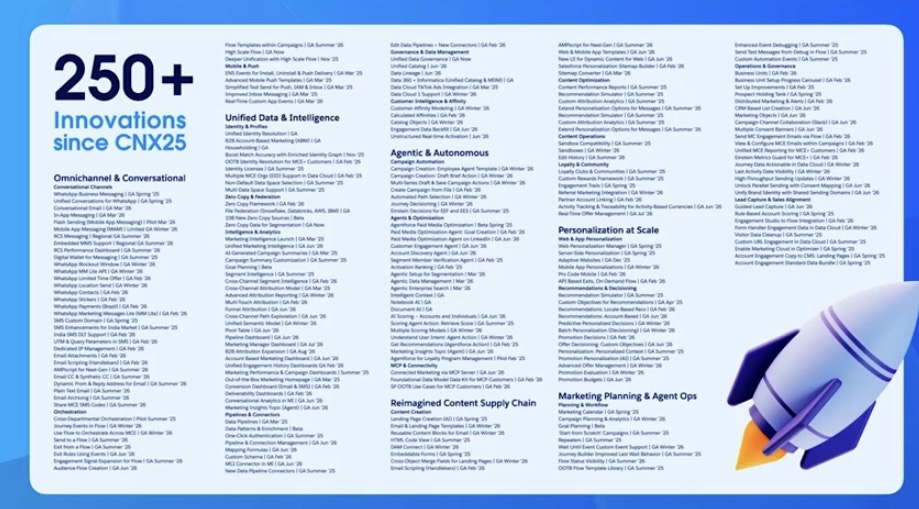
That number tells a story. Salesforce is not slowing down. Across content generation, personalisation, autonomous agents, intelligence, and conversational engagement, the investment is significant and sustained. For anyone tracking Agentforce Salesforce strategy, that pace makes clear this is becoming a broader operating model, not a standalone feature set.
But 250 innovations in 12 months also raises a practical question for every marketing leader sitting in that room: how much of this has your organisation actually adopted?
For most, the honest answer is: not much. That gap between what is available and what is operational is where the real work happens. It is where Bluprintx spends most of its time with clients, and it is the conversation CNX26 brought sharply into focus.
Five Announcements Worth Understanding
Goals over tasks: the Marketing Goals Agent
The Marketing Goals Agent is still in pilot, but it signals something important about where Salesforce is taking the marketer's role. Rather than configuring campaign optimisations manually, marketers define outcomes and guardrails. Agents work continuously toward those outcomes.
This is not a small shift. It asks marketers to think more like strategists and trust agents to handle execution. For organisations still building confidence in AI marketing, the change management implications are real.
.jpeg)
Content as a supply chain: the Content Agent
The Content Agent reframes how creative and content teams operate. Generate channel-ready content from a campaign brief, grounded in audience context and brand guidelines. Reduce the time spent on variation production. Redirect that time toward strategy and judgement.
For marketing teams under resource pressure, this is the kind of capability that changes how you staff and structure a function. It also says something broader about where AI marketing tools are heading: away from isolated prompts and toward embedded workflow support.
.jpeg)
Intelligence as infrastructure: Unified Intelligence
The theme running through both the PAB day and the keynote was this: AI without context is limited. AI with context is genuinely powerful.
Unified Intelligence is Salesforce's answer to that context problem. It brings together customer data, engagement signals, analytics, and business context into the layer that both marketers and agents draw on to make decisions. It is not a product you buy once. It is a foundation you build.
That matters for any organisation evaluating marketing automation software or marketing automation tools more broadly. The differentiator is no longer just whether AI exists in the platform. It is whether the platform can apply AI in context, across channels and decisions, in a way that is actually useful.
Existing investments protected: the Marketing MCP Server
For Marketing Cloud Engagement customers, this announcement mattered most.
The question I hear most often from clients is some version of: do we need to rebuild everything to participate in the AI future? The Marketing MCP Server is a strong signal that the answer is no. Salesforce is building bridges between current platforms and future capabilities. Customers can extend what they have rather than replace it.
This aligns with how Bluprintx approaches platform strategy: protect what is working, extend with purpose, and sequence change in a way that does not disrupt what is already delivering value.
Governance at scale: the Unified Brand Center
As generative AI increases the volume of content being produced, the Unified Brand Center becomes less of a nice-to-have and more of a business requirement. Managing brand voice, visual identity, and content governance centrally is how organisations ensure AI-generated output stays aligned with who they are.
For B2B marketing leaders in particular, this matters because scale without governance creates as many problems as it solves.
.jpeg)
The Announcement That Did Not Make the Keynote
Beyond the stage, a roundtable conversation gave me the most instructive example of AI adoption I encountered all week.
An organisation in a highly regulated industry had built automated weekly reporting using Salesforce APIs and Claude. Brokers receive personalised summaries showing how their customers engaged with campaigns, which customers need follow-up, and the reasoning behind each recommendation.
No autonomous marketing department. No experimental pilot. Just a useful, repeatable workflow that saves time and improves consistency.
> Twelve months earlier, teams in regulated industries were asking whether AI belonged in their marketing function at all. This year, they were sharing what they had already built.
That shift is significant. It tells me the market is moving beyond curiosity and into application. And it is the kind of outcome that should be informing how marketing leaders frame their own AI roadmap right now.
What This Means for Marketing Leaders
CNX26 was not about introducing a new vision. It was about the industry beginning to close the gap between what Salesforce has built and what organisations are actually running.
The capabilities are there. The platform investment is real. What most organisations still need is a clear picture of where to start, how to sequence adoption, and how to build internal capability alongside the technology.
That is the work. And for marketing leaders who are ready to move from experimentation to operational AI, the window to get ahead of it is now.
FAQs
What was the biggest marketing AI takeaway from Salesforce CNX 2026?
The biggest takeaway was that the conversation has shifted from possibility to adoption. Salesforce showed that the technology stack is maturing quickly, especially across Agentforce, content generation, intelligence, and governance. The harder question for most marketing leaders is no longer what the platform can do, but what their organisation is actually ready to operationalise.
What is Salesforce Agentforce and why does it matter for marketers?
Salesforce Agentforce is the company's broader approach to agentic AI, where autonomous or semi-autonomous agents act on goals, context, and rules rather than waiting for manual input at every step. For marketers, that matters because it changes the role of the team. The value shifts from setting up individual tasks to defining outcomes, guardrails, and decision logic.
How does Marketing Cloud fit into Salesforce's AI strategy?
Marketing Cloud is now the umbrella of Agentforce Marketing and sits at the centre of how customer engagement, campaign execution, and AI decisioning come together. At CNX26, the direction of travel was clear: AI is being embedded more deeply into Agentforce Marketing through agents, content capabilities, and intelligence layers. The strategic point is that AI is not being added as a separate bolt-on. It is becoming part of how the platform operates.
What is the Marketing Goals Agent?
The Marketing Goals Agent is a Salesforce capability, currently in pilot, that points toward outcome-based marketing orchestration. Instead of manually adjusting settings and workflows, marketers define the goal they want to achieve and the constraints that matter. The system then works toward that goal continuously. It reflects a broader shift in AI marketing from task automation to goal-led execution.
What is the Marketing MCP Server and why is it important?
The Marketing MCP Server matters because it suggests a more practical path into the next phase of Salesforce AI. For many organisations, the concern is whether they need to replace existing marketing infrastructure to benefit from newer capabilities. This announcement indicated that Salesforce is focused on extending current investments and creating a bridge between today's Marketing Cloud environments and tomorrow's agent-based workflows.
Are AI marketing tools ready for enterprise use?
Some are, but readiness depends less on the tool itself and more on the operating environment around it. The most successful use cases tend to have strong data foundations, clear governance, a defined business problem, and a team prepared to work differently. Enterprise adoption is happening, but usually through specific, high-value workflows rather than all-at-once transformation.
What should B2B marketing leaders do next after CNX26?
Start with the gap between available capability and current adoption. Identify one or two use cases where AI can improve speed, consistency, or decision quality without forcing a complete overhaul. Then build the supporting pieces: data readiness, governance, process ownership, and clear success measures. That approach is usually more effective than trying to deploy every new feature at once.