



Salesforce launched Agentforce in 2024 to unify its enterprise AI capabilities into a single operational layer. Built on Einstein AI, Agentforce moves beyond assistive predictions, enabling agents to reason through decisions and execute across end-to-end enterprise workflows.
As a new platform in the AI landscape, Agentforce is still defining how it performs in real production environments. Since 2024, Bluprintx has delivered many Agentforce deployments, giving our teams early, hands-on insight into how the platform behaves at scale.
What we’ve learned from teams entering production is consistent. Agentforce delivers its earliest wins by removing friction from high-volume, rules-driven work, and by deflecting support load through fast knowledge retrieval and intelligent case triage. In practice, success depends less on the agent itself than on how clearly the work has been designed for the agent to perform.
Saleforce Agentforce Definition:
Agentforce is Salesforce’s platform for creating autonomous AI agents capable of executing actions on Salesforce systems and acting on behalf of humans when confidence dips. At a fundamental level, it is a decision layer meant for work in real business workflows.
Teams build on our experience around Agentforce implementations, where they find, during high-volume, rule-driven work, that Agentforce makes friction-free. Some common examples include patient engagement workflows that work for intake and follow-ups or support deflection from knowledge lookup and case triage. In each case, success depends less on the agent itself than on how plainly the work has been designed for it to be successful.
Is Agentforce Just Einstein Copilot Rebranded?
It is true that Agentforce builds on Einstein. Agentforce marks a structural change in the way AI works inside Salesforce. Architecturally, Agentforce adds an important layer of true reasoning. Einstein was assistive, providing predictions and suggestions. Agentforce implements the Atlas Reasoning Engine, which allows agents to plan steps, take actions, and confirm results.
How Agentforce Works: The Basics
At a high level, Agentforce combines configuration, data, and reasoning to make decisions and take action inside Salesforce.
- Agentforce Builder: Defines what the agent does and where it can operate. Teams set topics, actions, and escalation rules.
- Data Library: Agents reason using real business data unified through Data 360. This includes CRM records, connected knowledge, and real-time signals.
- The Atlas Reasoning Engine: Breaks requests into steps, selects appropriate actions, validates results, and repeats the loop until confidence is reached or escalation is triggered.
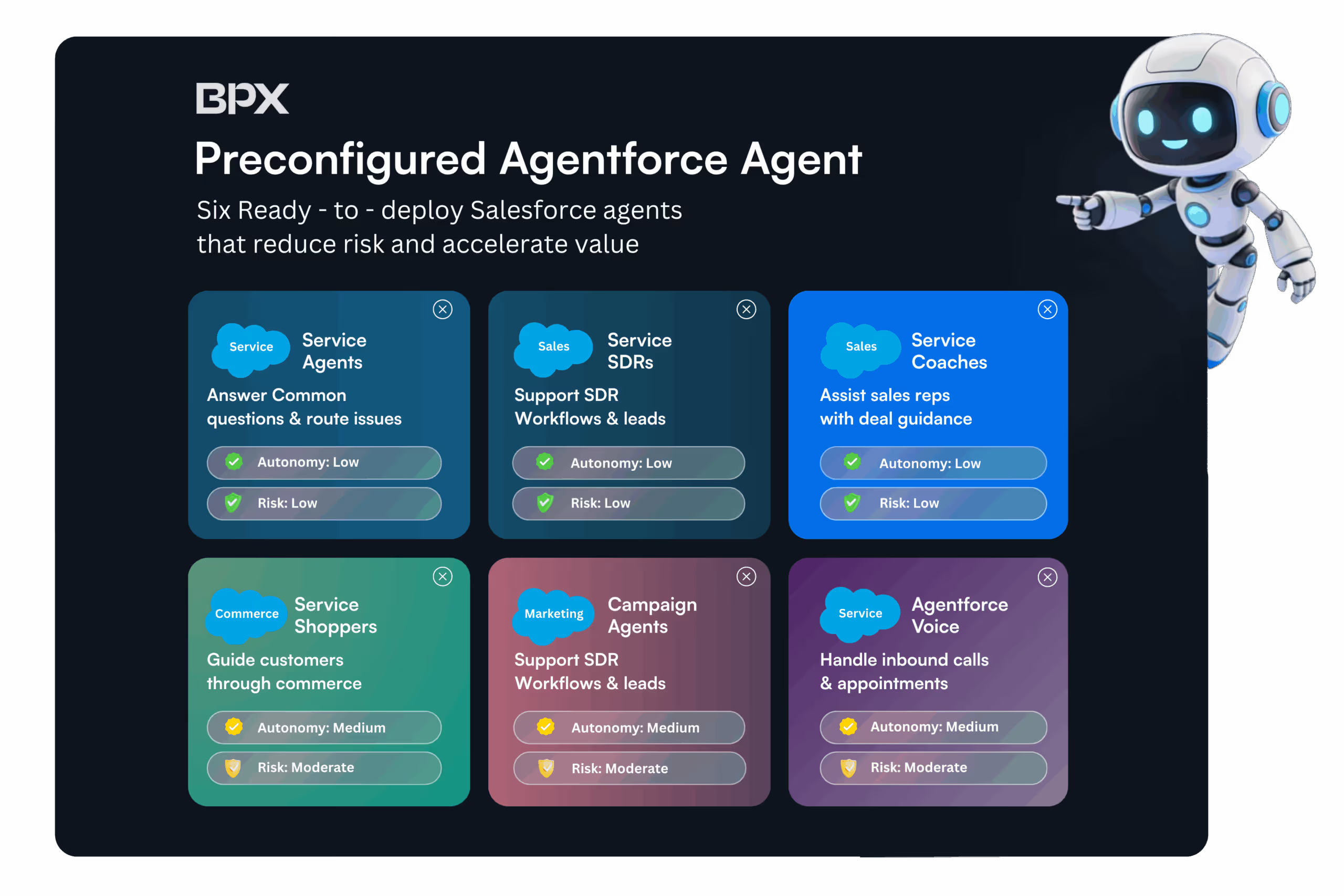
The Preconfigured Agentforce Agents
A preconfigured Agentforce agent is an out-of-the-box agent template created by Salesforce to facilitate standard enterprise tasks.
Their benefit is not that they are “plug and play,” but that they are production-oriented by default.
Every Preconfigured Agent:
- Has a pre-defined scope of responsible action.
- Operates on Salesforce clouds like Sales, Service, and Marketing.
- Provides built-in escalation paths that allow humans to take control of the situation.
- Is customizable with data, rules, and risk profile alignment within an organization.
In fact, successful teams treat preconfigured agents as the first layer and not as the final answer. They are usually deployed internally first, see the changes in real business processes, and then iterate as data and processes are validated. With automation, the spread continues on trusted foundations.
- Service Agents: Often used to answer common questions, route issues, and introduce relevant knowledge at scale.
- Agentforce SDRs: Targeting sales development workflows, these agents help support pipeline visibility, follow-up leads, and deal coordination across teams and regions.
- Sales Coaches: Designed to guide sales representatives on next-best actions, actions to be taken next, and insights into performance based on the stage within the pipeline and activity history.
- Personal Shoppers: For commercial use cases, these agents shepherd customers through product discovery, recommending products and helping them make purchases.
- Campaign Agents: These tools are employed in the marketing workflows to recognize audiences, personalize messaging, and initiate outbound communications.
- Agentforce Voice: Allows agents to interact in voice-based conversation for service and booking requests and appointments, serving up an integrated use case that handles inbound calls, appointments, and routine calls using conversational voice interfaces.
Preconfigured agents should be tailored to an organization. They minimize the set-up time and establish known patterns, but their effectiveness does still depend on the definer of goals, processes, and guardrails that are defined prior to production.
Additional Customization: Deterministic vs. Non-Deterministic AI
Once agents enter production, the more fundamental design question arises: What to do with the behavior of the agents? Are they to be deterministic or non-deterministic?
Deterministic systems behave the same way every time, such that the same inputs always yield the same consequences. In the case of non-deterministic (probabilistic) systems, variability is added, and outcomes are assessed based on likelihoods as well as confidence scores. Regulatory exposure, reputational risk, and mission-critical outcomes all call for a careful choice for this process.
Deterministic Workflows for Compliance-Heavy Environments
Agents in industries such as health and social impact are typically programmed to work in deterministic ways. It means the same inputs will always lead to the same outputs. Deterministic behavior facilitates auditability, compliance, and trust and resolves ambiguity problems with tightly controlled or sensitive processes.
Controlled Autonomy for Mission-Critical Processes
Agents sometimes require deterministic workflows and have no absolute decision-making ability. A great example of this is BPX’s work with AVPN. Agents consume information and format recommendations, but decisions ultimately belong to human stakeholders. They have transparency and accountability but reduce manual effort.
What Is Agentforce Going to Do for Enterprise Tech?
At the enterprise level, Agentforce is not about replacing people. It changes how scale works. Organizations can carry more volume, serve more markets, and support more complexity and without building headcount at the same rate.
Automation Without Proportional Headcount Growth: Agentforce performs repetitive, high-volume requirements that drive hiring as demand increases. If agents own well-defined parts of workflows, it can relieve growth pressure for human teams to focus on their other work.
Scaling Service, Support, and Engagement Globally: With agents working with centralized data and standardized processes and workflows, they scale more consistently than human-focused teams. It allows for growth in all time zones and geo areas without compromising service performance or operational visibility.
Key Successes in BPX’s Deployments
- Lower no-shows at Pacific Smiles Dental and increased reactivation from patient contact and repeat visits.
- Growth that is sustainable and doesn’t become overwhelming for EFEX, by utilizing service agents in lieu of typical IT requests.
- Zip Water: Global scale without service degradation, offering global customers seamless service across dozens of countries.
- AVPN has fast capital-to-impact matching where the agent composes the data, recommends actions, while humans create the final judgment.
- Operational clarity and regional expansion at HEPMIL, with integrated pipelines and automated workflows across markets.
The Future of Agentic AI
The success of Agentic AI won’t depend solely on the performance of the model. In the enterprise, systems like Agentforce are a success, or failure, based on fundamentals that do not hinge on hype but execution.
Which Is Why Agentforce Succeeds or Fails
- Objectives that specify what the agent should achieve and what the action belongs to the agent and the measurement of success.
- Well-defined workflow processes that translate actual operational behavior into coherent decision paths that are repeatable in which real-time behavior of operations are transformed into decisions.
- Data readiness — when agents can trust the trust of the agent with accurate, up-to-date, and interconnected data.
What These Actions Would Mean
- Begin assistive and move quickly to automate, providing agents time to build trust against autonomy.
- Assess ROI by processes, not by features, focusing on how the business actually benefits, and not on an AI ability.
- Treat Agentforce not as a chatbot but as operational infrastructure and treat it like core systems, designing it using the same discipline.
The takeaway is straightforward. Agentic AI is only transformational if it is considered as an integral part of the business, rather than as something you bolt on to it.
