



Over the past two years there has been a distinct shift in how business leaders view Artificial Intelligence. Initially, clients marveled at an AI’s ability to draft an email, summarize a report, or generate code. But after the initial wonder wore off, Generative AI presented its severe limitations. It requires constant human direction. It stops at the point of creation. It leaves the actual execution of the workflow entirely to human employees.
But, we are now entering a new era. Agentic AI introduces a fundamentally different model. We are witnessing the evolution from reactive prompting to autonomous execution across enterprise systems. This shift forces organizations to rethink not just their technology architecture, but the very nature of how work gets done.
In this comprehensive analysis, we will explore the core differences between these two technologies, examine how autonomous workflows function, and outline how this is transforming sales, service, and operations.
Key Takeaways
Enterprise AI is shifting from reactive Generative AI (which creates content based on human prompts) to proactive Agentic AI (which autonomously executes complex, multi-step workflows). While Generative AI stops at the point of creation, Agentic AI actually acts. It is adept at perceiving data, planning solutions, and taking direct action across enterprise systems like CRMs and APIs to achieve specific goals. Together, they form an autonomous digital workforce that eliminates operational bottlenecks, scales productivity, and elevates human employees from manual task-executors to strategic orchestrators.
Defining the Core Difference: Reactive vs. Proactive
To understand the future of enterprise workflows, we must first establish a rigid boundary between two distinct paradigms of artificial intelligence. They are often conflated in media narratives, but technologically and operationally, they serve entirely different purposes.
Generative AI Creates
Generative AI is a reactive partner. It crafts text, images, and code based on vast historical data patterns. When an employee types a prompt into a chat interface, the generative model calculates the statistical probability to construct a coherent response. It is highly sophisticated, but at its core, it is an advanced synthesis engine.
Agentic AI Acts
Agentic AI, conversely, is a proactive system. It is designed to execute complex, multi-step tasks to achieve specific, pre-defined goals. If a generative model is a consultant offering advice, an agentic system is an employee empowered to make decisions and execute them.
To clarify this distinction, we can define Agentic AI by three core characteristics:
- Autonomy: The system performs tasks without step-by-step human oversight. Once an overarching goal is established by human operators, the agent navigates the intermediate steps required to complete that goal independently.
- Adaptability: An agentic system learns from its interactions. It changes plans dynamically based on real-time feedback. If it encounters an error or a locked API gateway, it does not simply crash; it attempts an alternative route to achieve its objective.
- Goal Orientation: The system interprets high-level objectives and uses logical reasoning to plot the best path to achieve them. It understands the "why" behind a process, allowing it to navigate complex, unstructured environments that would break traditional automation.
Visualizing the AI Evolution
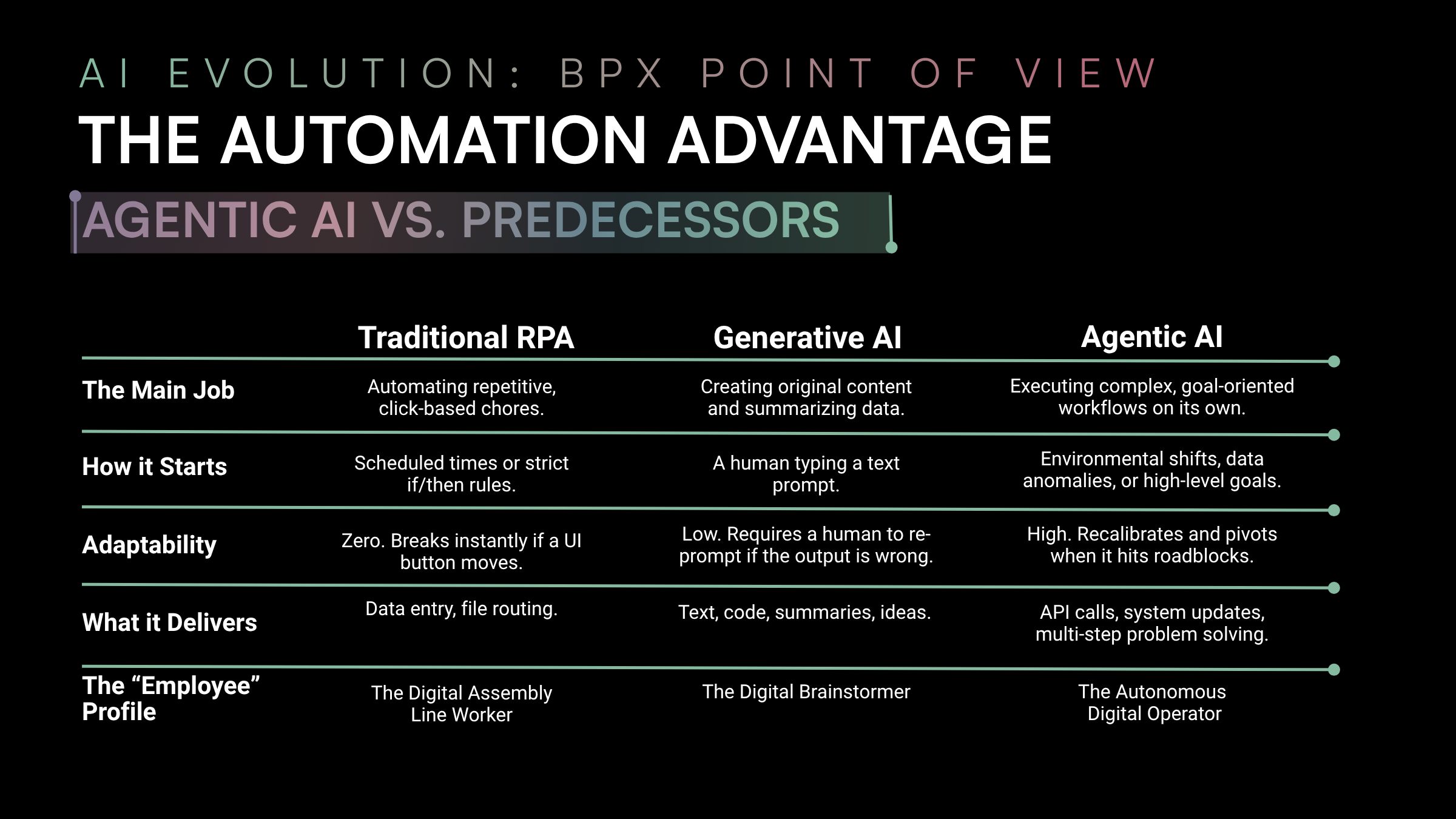
To contextualize where Agentic AI fits into the enterprise technology stack, it is helpful to compare it against both Generative AI and traditional automation tools like Robotic Process Automation (RPA).
How Agentic AI Works: The Autonomous Workflow
Moving beyond simple Robotic Process Automation requires a fundamental shift in system architecture. RPA follows static, rule-based coding. It is fragile. If a button moves on a screen, the RPA bot fails. Agentic AI, however, leverages Large Language Models (LLMs) as reasoning engines. It doesn't just follow a script; it interprets a situation.
This reasoning process generally follows a continuous three-phase loop: Perception, Planning, and Execution.
1. Perception
An agentic system must first understand its environment. It evaluates context and ingests real-time data from various enterprise systems. This might involve monitoring a shared customer support inbox, reading incoming API payloads from an e-commerce platform, or listening to database webhooks. The agent uses natural language processing to parse unstructured data (like an angry customer email) and extract the core intent, urgency, and necessary factual entities (like order numbers).
2. Planning
Once the system perceives a problem or an objective, it determines the multi-step path required to achieve a resolution. This is where the reasoning capabilities of advanced AI shine. The agent simulates potential outcomes. It checks its available "tools" (APIs, database access, internal documentation). It formulates a sequence of steps. For example, it might reason: To resolve this issue, I must first query the CRM for the customer's tier, then check the inventory database for the SKU, then calculate the refund eligibility based on our return policy.
3. Execution
The final phase is taking direct action. The agent executes the plan by interacting with enterprise systems just as a human would, albeit much faster. It makes API calls to third-party logistics providers, executes SQL scripts to update CRM records, or provisions cloud resources. If an execution step fails, the agent reverts to the planning phase, assesses the error message, and attempts a new strategy.
The Power of Working Together: Generators and Agents
It is crucial to understand that Generative AI and Agentic AI are not mutually exclusive, instead they form the ultimate enterprise technology team. You can think of Generative AI as the communicator. Agentic AI is the executor.
Enterprise platforms are already beginning to operationalize this synergy. For instance, Salesforce Enterprise AI solutions are increasingly built around this dual-engine approach. Within these environments, the operational framework relies on agents to handle the heavy lifting of data manipulation and system orchestration, while relying on generative models to handle the human interface.
Consider the capabilities of a platform like Salesforce Agentforce. In a complex service scenario, an autonomous agent might navigate multiple backend systems to authorize a warranty replacement, calculate shipping logistics, and update a customer's lifetime value score. That is the agentic action. However, when it comes time to notify the customer, the system leverages Generative AI to draft a highly empathetic, context-aware email. The generative model ensures the tone aligns with the brand's voice and acknowledges the specific inconvenience the customer faced, while the agent ensures the underlying business process was actually completed.
This combination allows enterprises to maintain a deeply human, personalized touch in their communications while achieving the massive scale and efficiency of autonomous backend operations.
Real-World Enterprise Use Cases
The theoretical applications of Agentic AI are vast, but its true value is found in tangible enterprise workflows. Organizations partnering with consultancies like Bluprintx are actively deploying these systems to solve persistent operational bottlenecks across revenue-generating and operational departments. Let's explore how these autonomous workflows are manifesting in the real world.
Sales: The Autonomous SDR
In B2B sales, Sales Development Representatives (SDRs) spend an enormous amount of time on repetitive tasks. Agentic AI transforms this function by deploying autonomous digital SDRs. When an inbound lead downloads a whitepaper, the agent instantly perceives the trigger. It autonomously enriches the lead data by querying platforms like LinkedIn or Clearbit. It evaluates the prospect against the company's Ideal Customer Profile (ICP). If the lead qualifies, the agent drafts a highly personalized email based on the downloaded content and the prospect's industry.
If the prospect replies with a common objection, the agent reasons through the objection, queries the sales playbook for the appropriate counter-narrative, and replies. When the prospect finally agrees to a meeting, the agent checks the human Account Executive's calendar and autonomously sends the calendar invite. The human seller only steps in when it is time to close the deal.
Learn more about Sales Automation>>
Customer Service: End-to-End Ticket Resolution
Traditional customer service software relies on complex routing rules and tiered escalation queues. A Tier 1 human agent acts as a router, handling basic queries and escalating complex ones.
Agentic AI allows for the end-to-end resolution of multi-step support tickets without traditional human routing. When a ticket enters the system, the agent analyzes the intent and immediately begins executing diagnostic workflows. For an internet service provider, an agent receiving a "slow connection" complaint can autonomously ping the customer's router, run line diagnostics, and check for regional outages. If a firmware update is required, the agent can push the update remotely. If a technician dispatch is necessary, the agent accesses the field service scheduling system, optimizes the route, books the appointment, and notifies the customer. The ticket is resolved from start to finish without sitting in a queue.
Learn more about Customer Service Management>>
IT & Operations: Proactive Anomaly Resolution
IT operations teams are frequently overwhelmed by alert fatigue. Monitoring systems generate thousands of alerts daily, many of which are false positives or minor issues that require manual verification.
Agentic AI shifts IT operations from reactive firefighting to proactive resolution. An autonomous agent continuously monitors enterprise network traffic and system health. When it detects an anomaly. It initiates an investigative workflow. It checks the recent deployment logs for conflicting code. It queries server load metrics. If it identifies that a rogue query is causing the latency, the agent can autonomously terminate the query, allocate additional cloud compute resources temporarily, and log a detailed incident report for the engineering team. It resolves the minor outage before end-users even notice a disruption.
Marketing Operations: Dynamic Campaign Orchestration
In enterprise marketing, an agentic system can serve as a central marketing orchestrator. Once a marketer defines the campaign goals and target audience, the agent autonomously queries the CRM to build the most accurate, up-to-date audience segments. It coordinates with generative models to adjust ad copy dynamically based on the real-time performance of different segments. If an ad platform's API reports a high cost-per-acquisition for a specific demographic, the agent autonomously reallocates the budget to higher-performing segments without waiting for a marketer's weekly review. This creates a self-optimizing marketing engine.
Learn more about Marketing Automation>>
Trust, Governance, and The Human Element
Delegating execution authority to an artificial intelligence system understandably causes apprehension among enterprise risk and compliance officers. With autonomy comes the critical need for strict guardrails, robust accountability frameworks, and unimpeachable data security. You cannot give an AI the ability to update financial records or send external communications without absolute certainty in its reliability.
Secure Data Grounding and Guardrails
Agentic AI is only as safe as the data it accesses and the boundaries placed upon it. Enterprises cannot rely on public, consumer-grade AI models to execute proprietary workflows. They require enterprise-grade architectures powered by secure data grounding.
This is where frameworks like the Einstein Trust Layer become non-negotiable. These architectures ensure that when an agent accesses enterprise data to make a decision, that data is masked, tokenized, and protected. Furthermore, zero-data retention policies must be enforced, ensuring that third-party LLM providers do not use proprietary enterprise data to train their external models.
Governance also requires strict access controls. An agent should only have access to the specific APIs and databases necessary to complete its designated role. A customer service agent must never have write-access to the core financial ledger. By implementing rigorous identity and access management (IAM) protocols for AI agents, enterprises mitigate the risk of catastrophic errors.
Auditability and Compliance
Every action taken by an autonomous agent must be logged, traceable, and explainable. When a customer asks why their loan application was denied or their refund was calculated a certain way, the enterprise must be able to produce a clear chain of reasoning. Agentic systems must output compliance logs detailing exactly which data points they perceived, what logical path they planned, and what API calls they executed.
Seamless Human-in-the-Loop Handoffs
Despite its autonomy, Agentic AI is not meant to replace human judgment entirely. The most effective implementations feature seamless human-in-the-loop (HITL) handoffs. Enterprises configure "confidence thresholds." If an agent encounters a scenario it has never seen before, or if its simulated plan falls below a 95% confidence score, it autonomously pauses execution and routes the context to a human operator for approval.
This fundamentally shifts the human role within the enterprise. Employees transition from being task executors to strategic orchestrators. Instead of spending eight hours a day resetting passwords or formatting spreadsheets, humans manage the agents. They review edge cases, optimize the agents' high-level objectives, and focus their energy on complex, creative, and high-value problem-solving that AI cannot replicate. The human becomes the manager of a digital workforce.
Real-World Impact: The ROI of Autonomous Workflows
The transition from generative experimentation to agentic deployment requires strategic investment and rigorous process mapping. However, organizations that successfully architect these systems are realizing exponential returns on that investment. The real-world impact of agentic workflows fundamentally alters the economics of the enterprise.
Exponentially Higher Productivity
By removing the human bottleneck from routine execution, enterprises achieve productivity levels previously thought impossible. A human employee can only process a finite number of tickets, leads, or invoices per day. An agentic system scales instantly to meet demand spikes. During a product launch or a sudden service outage, autonomous agents can process tens of thousands of concurrent workflows without breaking a sweat, ensuring SLA compliance even under massive load.
Reduced Bottlenecking in Daily Operations
Traditional enterprise workflows are plagued by hand-offs. A task moves from Marketing to Sales, or from Tier 1 Support to Billing. Every hand-off introduces friction, delay, and the potential for lost information. Agentic AI eliminates these operational silos. Because an agent can interface directly with the marketing automation platform, the CRM, and the billing software simultaneously, it completes the cross-departmental workflow in a single continuous motion. This drastically reduces cycle times and accelerates revenue realization.
Scalable, Personalized Customer Experiences
Consumers expect instantaneous, highly personalized responses. Generative AI allowed companies to personalize the text of a message, but Agentic AI allows them to personalize the resolution. When an AI can instantly navigate back-end systems to offer a tailored discount, reroute a package in real-time, or proactively fix a technical issue before the customer complains, it builds profound brand loyalty. It delivers a white-glove, concierge-level experience to every single customer at a massive, global scale.
Freed Capacity for Strategic Innovation
Perhaps the most significant impact of Agentic AI is what it does for the human workforce. When you strip away the mundane, repetitive execution tasks, you free up massive amounts of cognitive capacity within your organization.
Sales teams can focus on building relationships and negotiating complex, multi-stakeholder deals. Customer service agents can focus on handling deeply emotional or highly complex customer crises requiring deep empathy. IT engineers can focus on architecting more resilient, secure cloud infrastructures rather than resetting passwords. By automating the routine, organizations unleash the creative and strategic potential of their human capital, driving long-term innovation and competitive advantage.
Preparing for the Agentic Enterprise
Implementing Agentic AI is not as simple as purchasing a new software license. It requires a strategic transformation of how an enterprise operates. Organizations must prepare their data infrastructure, clean their CRMs, and deeply map their existing processes. An autonomous agent will only automate bad outcomes faster if the underlying business processes are broken.
Enterprises must work closely with implementation experts to audit their workflows, identify the optimal use cases for autonomous action, and architect the secure data pipelines required to feed these systems. It requires a holistic view of technology, people, and process.
Final Takeaway
The AI hype cycle of the past two years focused entirely on creation. Generative AI showed us what artificial intelligence could think and what it could say. It proved that machines could synthesize vast amounts of information and communicate in natural language. But thinking and saying are only the precursors to value.
Agentic AI shows us what artificial intelligence can actually do. It is transforming enterprise workflows from static, human-dependent processes into dynamic, self-executing systems. By combining the conversational intelligence of generative models with the autonomous execution capabilities of agentic frameworks, businesses are moving beyond the era of the digital assistant and entering the era of the autonomous digital workforce. The enterprises that embrace this shift from proactive prompts to proactive action will not just operate faster; they will redefine what is possible in their industries.
FAQ
Is generative AI the same as agentic AI?
Not at all. Think of Generative AI as a writer or creator. You give it a prompt, and it drafts an email, summarizes a document, or writes code.
Agentic AI, on the other hand, is a doer. It doesn't just sit around waiting for you to tell it what to do next. You give it a high-level goal, and it autonomously figures out the steps and actually executes the work on its own.
Will Agentic AI replace Generative AI?
No, they are actually highly complementary. In modern enterprise platforms, they form a synergistic dual-engine approach. Agentic AI acts as the executor, handling the heavy lifting of backend data manipulation and problem-solving. Generative AI acts as the communicator, translating the agent's actions into on-brand language (such as drafting a tailored email to a customer once their warranty issue is autonomously resolved).
How do Agentic AI systems solve problems autonomously?
Traditional automation (like RPA) is incredibly rigid. if a website button moves by an inch, the whole system breaks. Agentic AI is different because it uses an active "think, plan, act" loop:
- It reads the room (Perception): It looks at incoming data like an angry customer email and picks out the core issue and urgency.
- It builds a roadmap (Planning): It looks at the tools it has access to (like your CRM or shipping database) and maps out the steps needed to solve the problem.
- It takes action (Execution): It actually does the work, like updating a database or calling an external system. If it hits a roadblock, it doesn't just crash, and it instead tries a different route.
How do businesses ensure autonomous AI doesn't make costly mistakes?
Nobody wants an AI rogue-trashing financial records. Companies protect themselves using a few practical guardrails:
- Strict boundaries: Just like a human employee, an AI agent only gets password access to the specific software it needs to do its job. A customer service agent will never have access to the company's main financial ledger.
- A paper trail: Every single thought, plan, and action the AI takes is logged. If something goes wrong, you can look back and see exactly why it made that specific decision.
- The "call a human" trigger: Companies set confidence thresholds. If an agent hits a weird, messy edge case and its confidence drops below, say, 95%, it hits the brakes and passes the issue to a human to take over.
What is the impact of Agentic AI on human employees?
It shifts humans from being task rabbits to managers. Instead of spending your entire day copy-pasting data between spreadsheets, routing basic support tickets, or manually checking shipping numbers, you become the manager of a digital workforce. You get your time back to handle complex, messy human problems, think strategically, and focus on creative work that AI can’t do.

.svg)
