

What is Zero Copy Architecture?
Imagine trying to reorganize a living room. In a traditional approach, every time you want to see how the sofa looks in a different corner, you have to drive to the furniture store, buy an identical sofa, carry it into the house, and place it in the new spot. If you change your mind, you throw the duplicate away and start over. It is exhausting, expensive, and incredibly inefficient. Now imagine if you could simply look at the corner and instantly project a solid, usable version of the sofa right there, without ever lifting the original. You are experiencing the room differently, but the underlying object never moved.
That is the essence of zero copy architecture. It is the ultimate teleportation for modern data.
In my work managing massive volumetric datasets and post production pipelines, where projects are built across demanding platforms like DaVinci Resolve, duplicating data to shift it between systems is a relentless bottleneck. Moving terabytes of media from a storage array to a compute node hemorrhages time and inflates infrastructure budgets. Frame design and data architecture are both functional languages, and when the syntax is clogged with unnecessary duplication, the entire system grinds to a halt.
When mapping out content strategies around the return on investment for advanced tools like Agentforce for enterprise operations, the exact same principle applies. You cannot build real time, agentic workflows or responsive enterprise systems if your foundational data is constantly stuck in transit.
Key Takeaways
- Zero Copy Architecture Defined: A software and hardware framework that allows different systems, applications, or departments to access, read, and manipulate the exact same dataset without physically moving, replicating, or duplicating the underlying ones and zeros.
- Immediate Access: By bypassing traditional extraction and loading phases, teams and applications gain real time access to live data, enabling faster decision making and instant analytics without waiting for overnight batch jobs.
- Slashed Storage Costs: Because data is not being copied into secondary storage environments or siloed data marts, organizations drastically reduce their cloud storage footprint and the massive infrastructure bills associated with holding duplicate information.
- Elimination of Version Control Chaos: A single source of truth is strictly maintained. When teams work via metadata pointers rather than physical copies, the risk of analyzing outdated, siloed, or conflicting data vanishes entirely.
What is zero copy integration?
For decades, the standard operating procedure in data management has been moving the data to the compute. If a marketing team needed to analyze sales records, data engineers would extract the data from a transactional database, transform it into an analytical format, and load it into a data warehouse. This process, commonly known as ETL (Extract, Transform, and Load), formed the foundation of traditional data architecture.
In a zero copy architecture, applications access data directly from a centralized source. Modern cloud platforms separate storage from compute, allowing systems to query live data without creating additional copies.
This reduces storage costs, eliminates many data synchronization issues, and minimizes the risk of errors introduced during data movement. Teams spend less time maintaining pipelines and more time using the data.
Zero copy integration is precisely what makes modern artificial intelligence and machine learning viable at scale. Artificial intelligence models require vast amounts of fresh data to remain accurate. If a system has to wait for a nightly batch copy process to update its tables, the artificial intelligence insights are inherently retroactive and stale. Zero copy allows these computational models to interact with the operational system's live data stream instantly.
For a deeper look into how enterprise ecosystems leverage this structural advantage, Salesforce's overview on zero copy architecture details how organizations are bypassing integration hurdles to build real time customer data profiles, effectively eliminating the traditional overhead that has slowed down digital transformation for years.
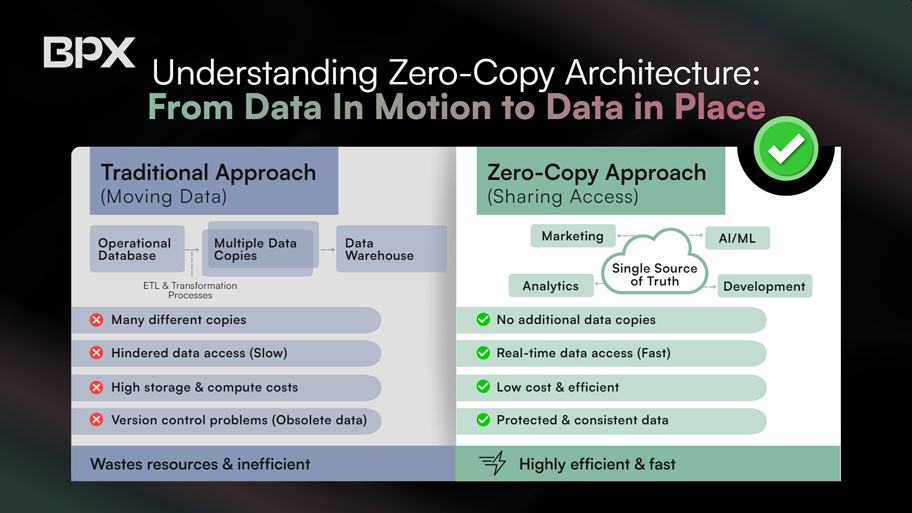
What is the difference between traditional copy and a zero copy approach?
Traditional data copying consumes significant system resources:
- CPU cycles are used to read, process, and write data between locations.
- Memory bandwidth is consumed holding data during transfers.
- Additional storage is required for duplicate datasets.
- Large data transfers can create performance bottlenecks.
- Multiple copies increase infrastructure and energy costs.
Zero copy architecture reduces these inefficiencies by keeping data in place:
- Lower CPU utilization.
- Reduced memory overhead.
- Smaller storage footprints.
- Faster access to data.
- More resources available for analytics and applications.
What is a data warehouse (and the OS Kernel)?
Zero copy architecture operates at two levels: the operating system and the cloud data platform. Understanding both helps explain how data moves efficiently without duplication.
The Operating System Level, Kernel Space vs User Space
Every single computer, server, and storage node runs a core operating system. This operating system is strictly divided into two primary memory zones for the sake of security and stability.
- Kernel Space: This is the highly privileged core of the operating system. It has absolute direct access to the underlying hardware, including the physical hard disks, the network cards, and the system memory.
- User Space: This is the restricted area where normal, everyday applications run. Your web browser, your video editing software, or your database applications all operate in user space. Software in user space absolutely cannot talk directly to the hardware. If an application in user space wants to read a file from the physical disk, it must politely ask the kernel space to fetch the file on its behalf.
How Zero Copy Works at the System Level
At the operating system level, zero copy reduces the number of times data must be transferred between storage, memory, applications, and network devices.
Traditional File Transfer
A typical file transfer involves multiple copies:
- Storage → Kernel Buffer
- Kernel Buffer → Application Buffer
- Application Buffer → Network Buffer
- Network Buffer → Network Interface Card (NIC)
Each transfer consumes CPU resources, memory bandwidth, and processing time.
How Zero Copy Improves Performance
Zero copy minimizes these transfers through technologies such as Direct Memory Access (DMA) and specialized system calls.
Key benefits include:
- Reduced CPU utilization
- Lower memory overhead
- Faster data transfers
- Higher system throughput
- Improved infrastructure efficiency
Instead of repeatedly copying data between system layers, zero copy allows information to move more directly between storage and network resources.
How Zero Copy Works in Cloud Data Platforms
Enterprise zero copy happens at the data platform level. Instead of creating duplicate datasets, platforms use metadata pointers to provide access to the same underlying data.
Metadata Pointers
When a table is shared or cloned, the platform does not create a physical copy. Instead, it creates a lightweight metadata pointer that references the original dataset.
Benefits include:
- Instant data sharing
- Faster environment provisioning
- Lower storage costs
- A single source of truth
To users, the shared dataset appears to be an independent copy. In reality, multiple users and applications are accessing the same underlying data.
Copy-on-Write
If multiple teams access the same dataset, how can one team make changes without affecting everyone else?
The answer is copy-on-write.
When a user modifies data, the platform creates a new copy only for the changed records. The original dataset remains untouched.
This approach provides:
- Data isolation for each user
- Protection of source data
- Minimal additional storage requirements
- Efficient version management
Organizations only store the changes, or deltas, rather than duplicating entire datasets. This is one of the primary reasons zero copy architectures are so efficient at scale.
Salesforce Data Cloud uses zero copy architecture to federate data from external platforms without requiring organizations to duplicate or migrate large datasets. This allows teams to work with current information while maintaining governance at the source.
Real World Impact: Accelerating transformation with zero copy
Zero copy architecture delivers measurable benefits across cost, speed, and governance. By eliminating unnecessary data duplication, organizations can scale more efficiently while maintaining a single source of truth.
Storage Costs and Infrastructure Savings
Traditional architectures often create multiple copies of the same dataset for analytics, development, testing, and reporting. Zero copy reduces this overhead by allowing teams to work from shared datasets while only storing changes when necessary.
Benefits include:
- Lower cloud storage costs
- Reduced infrastructure overhead
- Fewer redundant datasets
Time to Value and Provisioning Speed
Creating a traditional database clone can take hours or days, depending on its size. With zero copy, new environments can be provisioned almost instantly because the platform creates metadata pointers rather than physical copies.
Benefits include:
- Faster development cycles
- Quicker testing environments
- Reduced operational bottlenecks
Governance, Sanity, and the Single Source of Truth
When data is copied across multiple systems, reporting inconsistencies become common. Different teams may work from different versions of the same information.
Zero copy helps maintain a single source of truth by allowing applications and users to access the same underlying dataset.
Benefits include:
- More consistent reporting
- Improved data governance
- Simplified access controls
- Reduced compliance risk
Frequently Asked Questions
What is Zero Copy?
Zero copy is an advanced architectural principle and operational framework where a computer system, application, or network purposefully accesses and utilizes data without physically duplicating or moving the underlying storage blocks. It relies heavily on direct memory access, intelligent metadata pointing, and streamlined system calls to process data seamlessly in place.
How does Zero Copy data work?
At a foundational hardware level, it bypasses the central processor entirely and streams data directly from the storage disk to network interfaces. At a cloud or enterprise level, it works effectively by strictly separating storage from compute. Instead of copying files to new physical locations, the system generates lightweight metadata pointers that direct users directly to the original data source, presenting the perfect illusion of a dedicated database without the massive physical footprint.
What are Zero Copy operations?
Zero copy operations refer to the specific commands and computational processes executed within this distinct architecture. Examples include utilizing native system commands to transmit network packets instantly, spinning up instantaneous clones of a massive data warehouse environment, or querying a vast data lake directly from a customer relationship platform without utilizing a traditional data extraction pipeline.
What are the benefits of Zero Copy?
The primary benefits include drastic reductions in cloud storage costs, a massive decrease in processor and memory overhead, the total elimination of brittle data pipelines, instant access to live production data for artificial intelligence and analytics, and the strict enforcement of a single, highly secure source of truth across an entire global organization.
What is the difference between zero copy architecture and a shortcut?
While they share basic conceptual similarities, a simple shortcut on a traditional desktop merely points to a file, and if you accidentally edit the shortcut, you edit the live original file, often causing accidental destruction. Zero copy architecture in modern data platforms utilizes a brilliant method called copy on write. It acts exactly like a shortcut until the very moment you try to modify the data, at that exact millisecond, it smartly isolates your changes, saving only the new data without altering the foundational original file in any way.
Does Zero Copy work across different cloud providers?
Increasingly, the answer is yes. Modern data architectures and specific platforms are aggressively championing federated or cross cloud zero copy data sharing. Through open table formats, these incredible platforms can effortlessly point to and query data residing in completely different cloud environments natively, doing so without ever forcing the client to migrate or expensively copy the data into a single, highly proprietary ecosystem.
What happens if the original source data is deleted or modified in a Zero Copy clone?
Because of the powerful copy on write mechanism, any modifications or deletions made within a cloned environment only affect the specific user making the changes, ensuring the original source always remains perfectly protected. If the original source data itself is updated or modified by a system administrator, the platform's time travel and metadata management systems guarantee that existing clones can either reflect the live updates instantly or confidently remain locked to the specific snapshot in time when the clone was originally generated, completely depending on the configured governance rules of the organization.