



Every analyst and data team lead knows the scenario all too well. It is Monday morning, and two different departments pull a revenue report from the exact same enterprise database. Marketing presents one number to the executive board. Finance presents a completely different number. Immediate chaos ensues as leaders demand to know who made a mistake and which department is inflating their numbers. The reality is that nobody is wrong. Both teams are just using completely different filters, different calculation parameters, and different business definitions baked into their distinct SQL queries. Marketing might be including projected renewals and trial conversions, while Finance only counts realized cash in the bank.
This scenario represents the heavy, hidden cost of a missing translation layer in your architecture. The issue is rarely bad data. The actual problem is the lack of a shared language defining what the information actually means.
The fix for this widespread enterprise problem is the semantic layer. This governed abstraction sits directly between your raw data and the people or AI agents who query it. It encodes your company definitions once so that every downstream tool, dashboard, and machine learning model works from the exact same foundational reality. Throughout my time consulting with enterprise data teams at Bluprintx, I have watched organizations spend millions of dollars on massive cloud storage systems only to have business users abandon the resulting dashboards because the numbers simply do not match their expectations. Understanding what this concept is and how it functions is not merely a data engineering concern. It is foundational for anyone building reliable analytics, self-service business intelligence, or AI-powered workflows at scale.
Key Takeaways
A semantic layer is a governed interpretive engine that sits between a data platform and its consumers. It acts as the ultimate translation bridge for analysts, business intelligence tools, and AI agents. By encoding definitions, metrics, and complex relationships centrally, it ensures that terms like "revenue," "churn," or "active user" mean exactly the same thing everywhere they are used.
Here are the core benefits of implementing this architecture:
- Consistent metrics: Company definitions and business logic are defined exactly once and then inherited by every single tool that connects to the framework.
- Self-service analytics: Non-technical users can query information confidently without knowing SQL or navigating complex underlying schema details.
- AI-ready data: Agents and large language models receive machine-readable business context rather than just raw column names and cryptic data types.
- Reduced duplication: One governed model completely replaces dozens of team-specific spreadsheets, isolated database views, and rogue queries.
- Faster time to insight: Analysts spend significantly less time reconciling conflicting definitions and far more time actually generating answers that drive revenue.
- Governance and lineage: Every metric and model remains fully traceable back to its original source, making audits and updates seamless.
What is a Semantic Layer?
At its core, a semantic layer is an abstraction mechanism that maps raw database objects to concepts that humans and systems actually understand. Databases store information in tables, columns, and complex joins that are designed specifically for computational efficiency rather than human readability. A database engineer might know that a table named "cust_acct_vw_02" joined with "txn_log_fct" yields a customer purchase history report. A marketing manager absolutely does not know that. This framework maps those physical tables to logical dimensions, measures, metrics, and hierarchies.
It is crucial to distinguish this concept from the physical storage beneath it. This framework does not store actual records. It stores meaning. It holds the strict rules, relationships, and definitions that determine how information should be read and combined. Think of it as a dictionary and an operational rulebook combined into one single digital asset.
Why is this becoming such a massive priority right now? Over the last decade, data platforms have grown incredibly fast. Cloud storage is cheap, and data ingestion is easier than ever. However, business vocabularies have simply not kept pace with this technical expansion. As more teams, specialized analytics tools, and autonomous AI agents connect to the exact same underlying foundation, establishing a shared language becomes critical infrastructure.
This separation of raw assets from their contextual meaning is a proven concept in other areas of enterprise technology. For example, modern content management systems like Adobe Experience Manager Sites use structured content models so that raw text can be dynamically assembled and presented across various digital channels without ever losing its core message. Similarly, enterprise digital asset platforms like Adobe Experience Manager Assets rely heavily on robust metadata taxonomies to give meaning and searchability to millions of raw image files. A data semantic layer does the exact same thing for numbers, metrics, and rows. As organizations scale their global infrastructure using cloud-native solutions like Adobe Experience Manager as a Cloud Service, having a centralized vocabulary ensures that information piped into personalization engines remains accurate, unified, and actionable.
What is the Difference Between a Semantic Layer and Raw Data Access?
To truly understand the value of this architecture, you must compare it to the traditional method of accessing information.
There is a massive hidden cost to raw data access. When you give teams direct access to database tables, every single department encodes their own version of reality in their own queries. Over time, this creates a sprawling web of conflicting definitions that fundamentally erodes trust in the organization. If the Chief Executive Officer gets three different numbers for weekly sales from three different department heads, they stop trusting the dashboard entirely. Centralizing these rules ensures they can be governed, easily updated, and universally trusted by every stakeholder.
What is a Data Platform (and Where Does the Semantic Layer Live)?
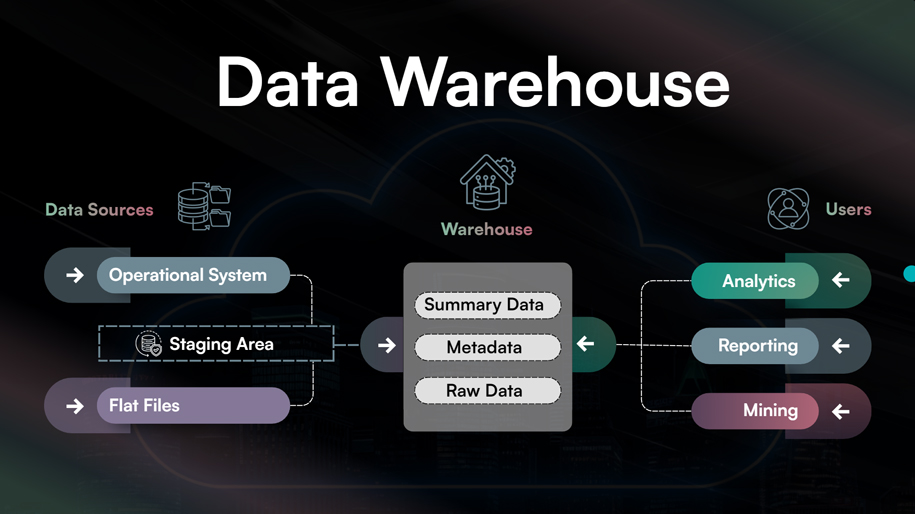
To fully grasp this concept, you need foundational context regarding the modern data stack. Today, enterprise architecture is essentially a pipeline of specialized tools used for ingesting, storing, transforming, and serving information.
First, raw records flow from business applications into massive cloud warehouses like Snowflake, Databricks, or Google BigQuery. Next, transformation frameworks like dbt clean and organize these records into structured tables. Finally, consumption tools like Tableau, Looker, or various AI agents connect to the warehouse to visualize the results and make decisions.
So, where exactly does the semantic model fit into this complex pipeline? It sits directly between the storage or transformation phase and the consumption phase. It is fundamentally not the warehouse itself. It is also not the business intelligence tool. It is the mediating framework that makes the complex warehouse intelligible to the dashboard and to everything else that connects downstream.
Historically, this function took two primary forms. First, it was often embedded directly within a BI platform. Second, the industry has shifted toward the standalone or universal model.
By choosing a universal model, companies ensure that their logic remains intact even if they decide to migrate from one visualization tool to another in the future.
How It Works: Under the Hood
Understanding the mechanics requires following a query as it travels from a user question to a final answer. Here is the exact step-by-step process of how this system operates in a live environment.
Step 1: Data Modeling
Data engineers or analytics engineers begin by defining the foundational model. They map physical database tables to logical entities. For example, a complex table filled with alphanumeric transaction IDs and raw server timestamps becomes the simple logical "Orders" dimension. They also establish basic measures. A column containing raw transaction amounts is mapped to a logical concept like "Total Revenue." Crucially, they encode join paths and hierarchies, such as establishing that a Date record rolls up to a Month record, which rolls up to a Quarter, which ultimately rolls up to a Year.
Step 2: Metric Definition
Next, specific business metrics are encoded with their exact mathematical logic. This includes granular details like custom filters, specific time grains, regional currency conversions, and rigorous deduplication rules. By defining this calculation here, an organization guarantees that "Monthly Recurring Revenue" always calculates the exact same way regardless of who or what is asking for it.
Step 3: Query Translation
When a user or an AI agent asks a question in natural language or submits a drag-and-drop request in a visualization tool, the framework takes over. It intercepts the request and translates it into highly optimized SQL tailored for the specific underlying warehouse. The consumer never actually sees the raw schema or writes a single line of code. The translation engine handles all the complexity of joining tables and applying the correct filters.
Step 4: Governed Distribution
Before returning the final answer, strict governance rules apply. Access controls, row-level security policies, and certification workflows ensure that users only see records they are explicitly authorized to view. Furthermore, they only access metrics that have been officially approved by the data engineering team. If an intern tries to pull a report on executive compensation, the layer blocks the query based on predefined permissions.
Step 5: Consumption
Finally, the result surfaces in whatever tool initiated the request. This might be a visual dashboard, a conversational AI interface, an automated financial report, or an autonomous workflow. The values are perfectly consistent because the mathematical logic was resolved far upstream in a highly controlled environment.
For further reading on how industry leaders implement these steps, you can explore the Databricks overview on this architecture or review the Salesforce Tableau Semantics product page to see embedded modeling in action.
How It Works: Semantic Layers and AI Agents
The rapid rise of artificial intelligence and autonomous agents actually makes this architecture significantly more important, not less. An AI agent operating autonomously has absolutely none of the implicit context a human analyst naturally carries. A human knows that "revenue" at your specific company excludes free trial accounts. A human analyst can fill in knowledge gaps from memory, search old Slack threads for context, or rely on tribal knowledge passed down from senior team members. An autonomous agent cannot do any of these things. It needs company meaning made absolutely explicit, highly governed, and perfectly machine-readable.
When an AI agent queries a database without this intermediary, the results are often disastrous. It receives raw column names and cryptic data types. It then makes wild assumptions about what they mean. The large language model might write a syntactically perfect SQL query that executes flawlessly and returns a number. The number will be mathematically correct based on the query, but it will be entirely contextually wrong for the business. This is exactly how AI hallucinations happen in enterprise analytics.
Conversely, when this framework is in place, the outcome transforms entirely. The agent receives structured context. It accesses certified definitions, clear entity relationships, and pre-approved synonyms. It can seamlessly reason over trusted records with the exact same confidence as a highly trained senior analyst. The AI no longer guesses how to join tables. It simply asks the API for "Total Sales by Region," and the API handles the underlying SQL generation safely. To see how major platforms are tackling this exact challenge, check out the Salesforce blog post on building an AI data framework.
Real-World Impact: What a Semantic Layer Changes in Practice
The theoretical benefits sound great on paper, but the practical impact on a living organization is what truly drives enterprise adoption. Bluprintx consistently sees four major transformations when clients implement this architecture.
Consistency Across Teams
Imagine a world where Finance, Marketing, and Product all pull a "conversion rate" report for a quarterly review. Instead of spending the first forty minutes of the meeting arguing about whose spreadsheet is correct, they all arrive with the exact same number. The endless arguments stop before they even start. The definition lives in one highly protected place, and every single department inherits that exact definition for their reporting.
Self-Service Without Chaos
A well-built model finally enables true self-service analytics. Analysts and non-technical business users can deeply explore information without constantly submitting IT support tickets. The necessary guardrails are completely built in. In the past, self-service often meant an ungoverned free-for-all where everyone wrote terrible SQL that crashed the warehouse and returned inaccurate data. Modern self-service means users are governed at the model level rather than the query level. They can explore freely because they cannot accidentally break the underlying business rules.
Faster AI Adoption
Organizations aggressively trying to deploy AI agents frequently hit a massive wall when their infrastructure is semantically incomplete. Establishing this interpretive engine is the absolute prerequisite infrastructure for reliable AI-powered analytics. Without it, companies spend months trying to prompt-engineer their way out of bad data. With it, deployment takes days because the AI interacts with a clean, logical API rather than a messy physical database. Proper preparation is key, as highlighted in comprehensive guides on preparing enterprise systems for AI trust layers.
Governance and Lineage
A centralized model creates full, unbroken traceability. Every single metric links directly back to its source tables, its specific transformation logic, and its official certification status. When a number suddenly changes week over week, you know exactly why. You can trace the lineage back to see if a data engineer updated a calculation parameter or if the raw inputs actually shifted. This visibility is vital for compliance and maintaining operational trust.
Frequently Asked Questions (FAQ)
What is a semantic layer?
It is a structured abstraction framework that sits between your physical data storage and your consumption tools. It maps complex technical database schemas into easily understandable business concepts, ensuring that metrics and definitions remain perfectly consistent across the entire organization.
How does a semantic layer work?
It works by intercepting queries from users or tools and seamlessly translating them. Engineers define physical table mappings, complex joins, and metric calculations in a central repository. When a user asks for "Revenue by Region," the system translates that plain text or drag-and-drop request into the precise, highly optimized SQL required to fetch the correct answer from the underlying warehouse.
What is the difference between a semantic layer and a data warehouse?
A data warehouse actually stores your physical records. It is the hard drive and computing engine where millions of rows of information live. The semantic model stores zero actual records. It strictly stores the business rules, mathematical logic, and corporate definitions dictating how the warehouse information should be interpreted and queried by outside tools.
What are the benefits of a semantic layer?
The primary benefits include universal metric consistency across all departments, the ability to offer safe self-service analytics to non-technical staff, a massive reduction in duplicated engineering effort, enhanced security, and the creation of a machine-readable foundation absolutely necessary for deploying reliable AI agents.
What is the difference between a semantic layer and dbt metrics?
dbt is primarily a transformation tool used to clean and structure tables inside the warehouse. However, dbt also offers its own specific semantic product. In this context, dbt metrics are simply one specific vendor's way of defining and serving these universal rules. The broader concept applies to the overarching architectural pattern, while dbt is one popular software provider executing that pattern.
Does a semantic layer work with AI and LLM-based tools?
Yes, and it is arguably the most critical component for making artificial intelligence work safely in enterprise analytics. Large language models struggle to understand raw database schemas because they lack internal company context. By forcing the AI to query a governed model instead of raw tables, you completely eliminate hallucinations and ensure the AI respects your official company calculation rules.
What happens if the underlying data schema changes, does the semantic layer break?
When the underlying warehouse schema changes, you only have to update the mapping in one single place. You update the connection within the semantic model itself. Because all of your downstream dashboards, executive reports, and AI agents point to the semantic model rather than the raw tables, they continue to function perfectly without requiring any individual updates. This centralizes maintenance and saves engineering teams hundreds of hours of debugging and broken dashboard triage.
