



Key Takeaways
Automated compliance routing is a set of rules and logic embedded directly within a Digital Asset Management system. It automatically directs assets to the correct reviewers, specific approval stages, and designated archiving workflows based on asset type, content, geography, regulatory category, or intended use. It does all of this without requiring any manual human triage.
Here are the core benefits of implementing this methodology:
- Speed to Market: Eliminates administrative routing delays, allowing assets to move through review pipelines instantly.
- Regulatory Defensibility: Ensures compliance with rules-based logic and provides an ironclad, audit-ready record for regulators.
- Governance at Scale: Enables compliance workflows to grow effortlessly with content volume, removing the need for additional headcount.
- Version Control & Asset Expiration: Maintains a single source of truth with automatic suppression of expired or unapproved content.
What is Automated Compliance Routing in DAM?
For decades, the standard review process relied heavily on ad hoc communications. A designer would attach a PDF to an email, guess which legal representative was on duty, and ask for a quick review. This chaotic shift from unstructured email workflows to structured, rules-based logic changes everything. Automated compliance routing completely removes the need for manual triaging. Nobody has to sit at a desk and decide who needs to see a specific file. The system replaces that human guesswork with precise software logic that fires automatically based on asset metadata, content classification, and intended commercial use.
This shift is especially important for financial services, healthcare, and pharmaceutical organizations. Regulatory requirements vary based on the type of asset. A credit card advertisement faces far more scrutiny than an educational article about compound interest.
Distribution channels add complexity. Social media campaigns require different reviews than print or television ads. Global firms must also comply with regional regulations. As content volume grows, manual routing becomes harder to manage.
What is the Difference Between Manual Compliance Review and Automated Compliance Routing?
To fully appreciate the value of this technology, you must compare it directly to the traditional method of asset approval.
There are massive hidden costs associated with manual routing. When teams rely on humans to move files from one department to the next, assets inevitably get misrouted. Reviews are missed entirely. Version sprawl occurs when legal marks up version three while the design team is already working on version four. Most importantly, this disjointed approach creates immense legal exposure. If an unapproved or outdated financial asset reaches a public channel, the resulting fines can be staggering. Automated routing provides absolute certainty. If the underlying logic is configured correctly, no asset can ever skip a required stage.
What is a Digital Asset Management System (and Why Compliance Lives There)?
A Digital Asset Management (DAM) system is the central nervous system of the modern content supply chain. It provides a secure, centralized hub for managing digital assets, from images and videos to legal documents, presentations, and brand content.
Many organizations attempt to manage compliance using external tools bolted onto their creative process. They might use a separate project management software or a dedicated legal review portal. This fragmented approach is fundamentally flawed. Compliance workflow belongs natively inside the Digital Asset Management system for three vital reasons.
- First, there is the advantage of metadata proximity. The compliance logic runs on the exact same metadata tags used to organize and retrieve the assets. If a file is tagged as a European financial disclosure, that single tag makes it searchable for the marketing team while simultaneously triggering the European legal review workflow.
- Second, housing this function natively creates a single, unbroken workflow. Content creation, legal review, final approval, and market distribution all happen securely within one unified environment. Files do not need to be downloaded, uploaded to a separate portal, and then downloaded again.
- Third, access control is drastically improved. Strict permissions and review stages are enforced firmly at the asset level. They are not managed loosely on an external spreadsheet. This is why enterprise platforms like Adobe Experience Manager Assets offer native workflow configuration tools.
Automated routing is especially valuable for enterprise organizations and regulated industries. In sectors such as financial services, pharmaceuticals, and healthcare, content governance is a legal requirement.
How It Works: Under the Hood
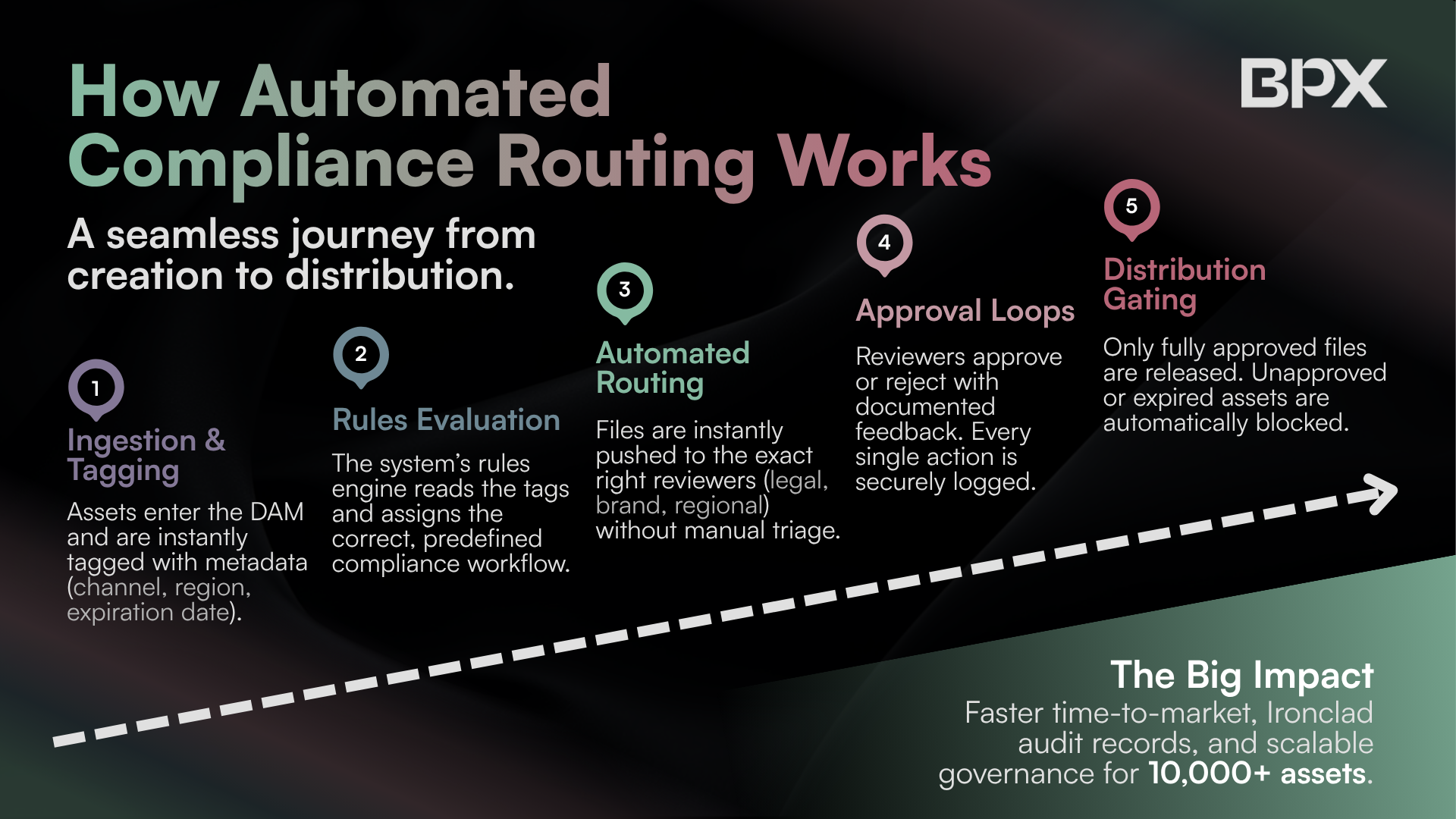
Understanding this technology requires looking at the exact journey an asset takes from initial creation to final public distribution. Here is the step-by-step process of how automated routing functions in a live environment.
.png)
- Step 1: Asset Ingestion and Metadata Tagging
These attributes determine how the file moves through the workflow. Asset type, distribution channel, geography, product category, and expiration date all influence the routing logic.
- Step 2: Rules Engine Evaluation
The rules engine then evaluates the file attributes and assigns the appropriate compliance workflow. Routing decisions are driven by predefined business rules and regulatory requirements.
- Step 3: Automated Routing to Review Queues
Once evaluated, the file is routed to the appropriate reviewers. This may include legal, compliance, brand, or regional teams. Reviews can occur in parallel or follow a predefined sequence.
- Step 4: Approval, Rejection, and Revision Loops
Reviewers approve or reject the file at each stage. Approved files move forward automatically. Rejected files return to the creator with feedback. All actions are logged to create a complete audit trail.
- Step 5: Distribution Gating
Only fully approved files can be distributed. Assets with pending reviews remain blocked. Approved content is released automatically, while expired or rejected files are suppressed. This often utilizes advanced integrations like Adobe Experience Manager Asset automation to push content to the web. Conversely, unapproved assets or older files that have reached their regulatory expiration dates are suppressed automatically and hidden from public marketing teams.
Real-World Impact: Accelerating the Content Supply Chain Without Cutting Compliance Corners
The theoretical mechanics of this system are impressive, but the real-world impact on enterprise marketing teams is transformational. Implementing this technology fundamentally changes how content supply chains operate under pressure.
Speed to Market
The most immediate impact is a dramatic acceleration in speed to market. When organizations analyze their production bottlenecks, they often discover that the actual legal review only takes twenty minutes. However, the asset sat in a digital waiting room for nine days before the lawyer ever opened it. Automating the routing process compresses cycle times significantly. It does this not by forcing lawyers to read faster, but by completely eliminating the dead time where files wait to be manually triaged, misrouted, or stubbornly resubmitted via email.
Regulatory Defensibility
A rules-based platform creates an ironclad, highly auditable record that satisfies aggressive regulators. Every single review stage, every incremental approval, and every minor version change is logged in a secure database. If your firm faces a sudden FINRA examination or an unexpected SEC inquiry, you do not have to spend weeks interviewing staff and searching through deleted email archives. You simply export the system log. That pristine digital record is the exact difference between a defensible operational process and a massively exposed one.
Governance at Scale
As a company grows, its content volume explodes. Marketing teams launch into more channels, expand into new international markets, and introduce complex new product lines. Under this pressure, manual compliance routing quickly collapses under its own weight. Humans simply cannot keep up with thousands of daily routing decisions. Automated routing scales effortlessly with volume. A financial services firm managing ten thousand distinct marketing assets per quarter can process them with the exact same administrative headcount they used for one thousand assets. The software handles the scale.
Version Control and Asset Expiration
Regulated industries deal heavily with time-sensitive content. Financial disclosures must be updated annually. Promotional interest rates expire at the end of the month. Legal language regarding pharmaceutical side effects changes based on new clinical trials. Automated compliance routing handles this elegantly. Rules can be configured to automatically route active assets for mandatory re-review thirty days before their expiration date. If the asset is not re-approved, the system suppresses it when the clock strikes midnight. This happens flawlessly without any human project manager having to set a calendar reminder.