



If you’re searching for “Salesforce AI agent,” you’re looking for Agentforce. That’s Salesforce’s purpose-built AI agent platform, and it’s already in production at enterprises handling millions of interactions autonomously.
The numbers tell the story quickly. OpenTable deployed an Agentforce agent in under three weeks and resolved 73% of cases without human involvement. Zota is projecting 180,000 cases resolved annually. Salesforce itself used Agentforce to handle over one million support requests on its own website.
These aren’t pilot programs. They’re production deployments at scale, and they signal a fundamental shift in how Salesforce customers, particularly sales and service organizations, are extending the value of their existing CRM investment.
The core shift: traditional Salesforce automation executes predefined workflows. AI agents reason, decide, and act autonomously, handling tasks that previously required human judgment. For sales teams specifically, that means engaging prospects 24/7, qualifying leads, handling objections, and booking meetings, without a rep ever having to be involved.
This guide explains what Salesforce AI agents are, how Agentforce delivers that capability, where it drives measurable business value in sales organizations, and what enterprise leaders need to assess before building the internal case for deployment.
Key Takeaways
- Salesforce AI agents are powered by Agentforce, Salesforce’s purpose-built autonomous agent platform
- Agentforce reasons, decides, and acts autonomously – it’s not a chatbot or a workflow rule
- The underlying intelligence is the Atlas Reasoning Engine, which breaks every request into auditable steps
- Agents operate across service, sales, marketing, employee support, and industry-specific functions
- OpenTable resolved 73% of cases autonomously within 3 weeks; Zota projects 180,000 cases handled annually
- Runs on your existing Salesforce infrastructure – no separate AI stack required
- Pricing is usage-based (Flex Credits), and every Salesforce customer can start for free via Salesforce Foundations
- The biggest deployment risks are data readiness and change management, not the technology itself
What Is a Salesforce AI Agent?
A Salesforce AI agent is an autonomous application that understands context, reasons through a problem, takes action, and escalates to a human when needed, all without requiring a human to trigger each step. Salesforce’s platform for building and deploying these agents is called Agentforce, and it is the definitive answer to what a “Salesforce AI agent” actually is in practice.
This is a meaningful distinction from earlier generations of CRM automation. Rules-based bots follow scripts. Workflow automation fires when conditions are met. Agentforce agents do something different: they interpret intent, retrieve relevant data, decide what action to take, execute it, and adapt if the situation changes.
For sales organizations, this distinction is particularly significant. An Agentforce SDR agent doesn’t wait for a rep to log in. It engages inbound prospects around the clock, answers product questions, handles objections, and books qualified meetings directly into a rep’s calendar, all grounded in live Salesforce CRM data.
How AI Agents Differ from Traditional Automation
Capability
Rules-Based Bot
Workflow Automation
Salesforce AI Agent (Agentforce)
Understands natural language
No
No
Yes
Handles multi-step reasoning
No
Limited
Yes
Adapts to context mid-conversation
No
No
Yes
Takes action across systems
No
Yes (predefined)
Yes (dynamic)
Escalates with full context
No
No
Yes
Operates 24/7 without intervention
Limited
Yes
Yes
The practical implication for enterprise leaders: agents can handle the kinds of interactions that previously required trained staff. Not just FAQ lookups, but multi-part questions, account actions, objection handling, and appointment scheduling, all grounded in your live CRM data.
The Atlas Reasoning Engine: Agentforce’s Intelligence Layer
The intelligence behind Salesforce AI agents is the Atlas Reasoning Engine, Agentforce’s proprietary AI reasoning layer. When a user sends a request, Atlas breaks it down into subtasks, evaluates what data is needed, determines what actions are required, executes them in sequence, and checks its work at each step before proceeding.
This is what separates Agentforce from a standard LLM wrapper. The reasoning is structured and auditable, not a single black-box inference. Enterprise teams can trace exactly how an agent reached a decision, which matters enormously for compliance, governance, and quality assurance.
Where Salesforce AI Agents Operate Across the Enterprise
One of the strongest arguments for Agentforce at the executive level is breadth. These agents aren’t confined to a single department or use case. They operate across every major business function that already runs on Salesforce.

Customer Service
Service agents handle inbound inquiries autonomously, resolving questions about orders, accounts, billing, and troubleshooting without a human in the loop. When a case exceeds the agent’s scope, it escalates to a human rep with a full transcript already attached, so the customer never has to repeat themselves.
OpenTable’s deployment illustrates the scale possible here. Their Agentforce deployment handles 11,000 conversations per week across both diner and restaurant agents, with a 73% case resolution rate achieved within just three weeks of launch. The team went from proof of concept to live deployment in under a month, with no custom code.
Sales Development: The Flagship Agentforce Use Case
The Agentforce SDR agent is where the platform’s commercial impact is most immediate for sales organizations. It engages prospects around the clock, answering product questions, handling objections, and booking qualified meetings directly into rep calendars. Every interaction is personalized based on account history, deal stage, and prospect behavior. Not just form fills.
The business case is direct: a human SDR works a finite number of hours and handles a limited number of conversations per day. An Agentforce SDR handles unlimited concurrent conversations, with consistent quality, at any hour, including weekends and time zones where your team is offline.
Salesforce’s own website deployment generated 1.8x higher lead conversion compared to the site average, handling product and pricing questions and routing qualified leads to reps for faster follow-up. That’s not a hypothetical ROI model. It’s what the platform did for Salesforce’s own sales pipeline.
Employee Productivity
Internal agents give employees on-demand access to answers, automated task execution, and guided workflows, all within the tools they already use, including Slack and Salesforce itself. IT helpdesk, HR inquiries, onboarding support, and compliance guidance are all viable deployment targets.
Marketing and Commerce
Campaign Optimizer agents automate the full campaign lifecycle, from audience segmentation to content personalization and performance analysis. Personal Shopper agents drive ecommerce revenue by delivering contextual product recommendations in real time, based on browsing behavior, purchase history, and live inventory.
Industry-Specific Deployments
Agentforce includes pre-built agent configurations for regulated and specialized industries:
- Financial services: Client request management, fraud detection alerts, compliance query resolution
- Healthcare: Patient and provider inquiry handling, appointment scheduling, care summaries
- Retail: Inventory-aware product recommendations, order management, campaign execution
- Technology: IT security monitoring, employee helpdesk, developer support
The common thread across all of these is that agents operate within the existing Salesforce data model, which means no separate AI infrastructure to build and maintain.
How Agentforce Is Built and Deployed
For C-suite leaders evaluating AI agents, the build-and-deploy question is often where internal skepticism concentrates. The assumption is that enterprise AI requires months of custom development, data science teams, and a separate infrastructure layer. Agentforce is designed to challenge that assumption directly.
Agent Builder: Low-Code to Pro-Code
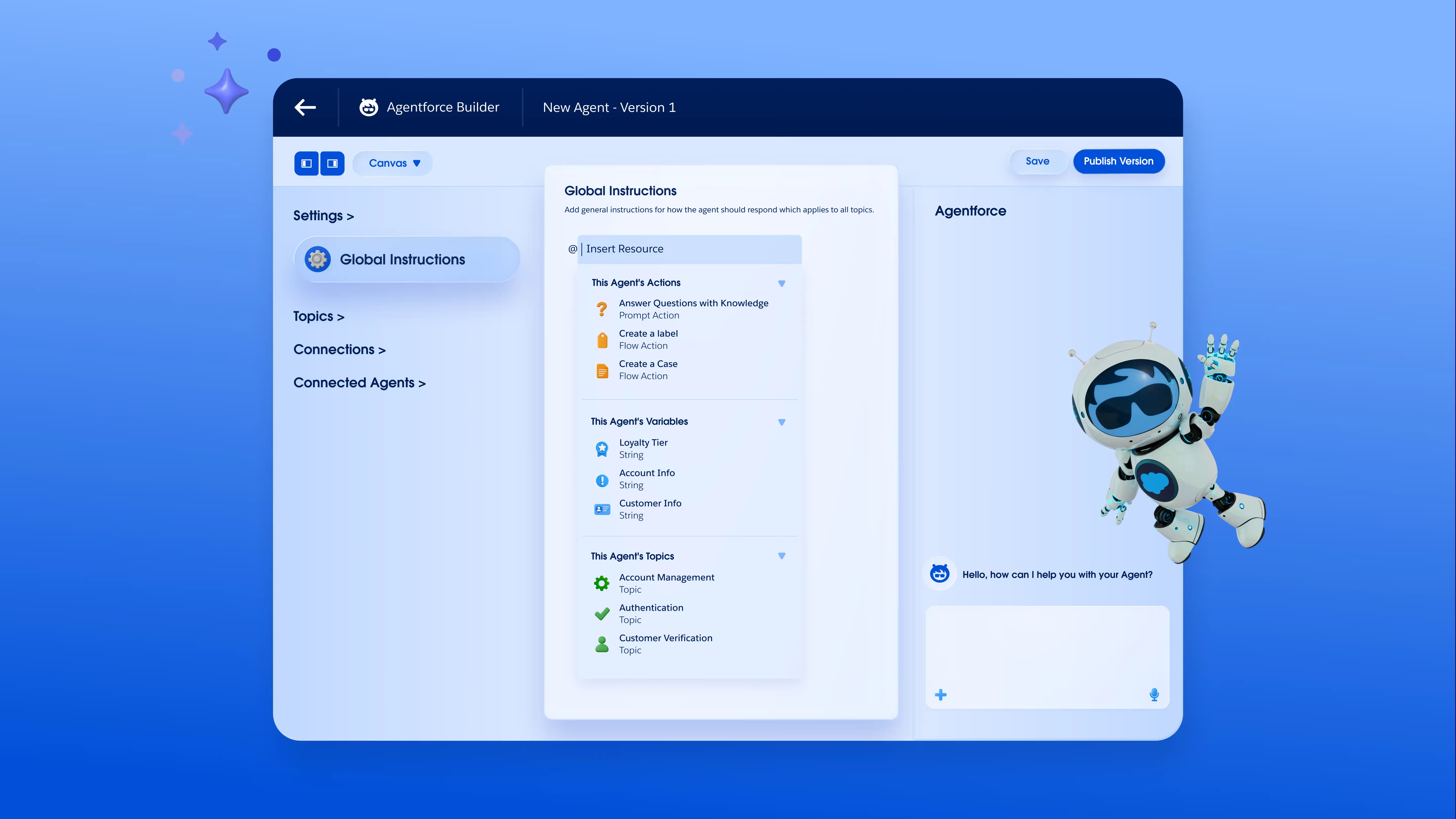
Agentforce Builder is the central workspace for creating, testing, and deploying agents. It offers three configuration paths depending on team capability:
- Natural language configuration: Describe the agent’s job in plain English; the platform generates topics, instructions, and actions automatically
- Low-code canvas: Drag-and-drop interface for non-technical admins to customize agent behavior using Flows, Prompts, and pre-built actions
- Pro-code scripting: Developers can write Apex or JavaScript for custom business logic, and connect to external systems via MuleSoft APIs
This flexibility means the same platform serves a Salesforce admin building a basic service agent and an engineering team deploying a complex multi-step sales workflow. Most enterprise deployments start with the low-code path and extend from there.
Data Foundation: What Makes Agents Accurate
An agent is only as good as the data it can access. Agentforce is grounded in live CRM data by default, but can also draw from:
- Data 360 (formerly Data Cloud): Harmonizes structured and unstructured data from external sources, enabling retrieval-augmented generation (RAG) so agents surface accurate, specific answers rather than generic responses
- Knowledge articles: Existing Service Cloud knowledge bases feed directly into agent responses
- External systems: MuleSoft connectors and the Model Context Protocol (MCP) allow agents to read and write data across third-party platforms
OpenTable’s agents are grounded in 1,500 knowledge articles stored in Service Cloud and indexed by Data 360. The result is that agents can answer highly specific questions, not just surface a list of links.
Trust, Guardrails, and Governance
This is the question most enterprise risk and compliance teams ask first: what stops an agent from doing something it shouldn’t?
Agentforce includes the Einstein Trust Layer, a built-in security and governance framework that covers:
- Zero data retention: Prompts and responses are not stored by the underlying LLM
- Dynamic grounding: Agents are anchored to your data, reducing hallucination risk
- Toxicity detection: Filters prevent inappropriate outputs
- Configurable guardrails: Admins define what topics agents can and cannot address, with hard limits that override LLM reasoning
These controls are on by default. They don’t require a separate security configuration project.
The Business Case: What Agentforce Actually Delivers
The ROI conversation for Agentforce is more concrete than for most enterprise AI investments, because the impact lands in measurable operational metrics: case resolution rates, conversation volumes handled, headcount requirements, and deal cycle length.
Operational Cost Reduction
The most immediate value is in service operations. Every conversation an agent resolves autonomously is a conversation that doesn’t require human agent time. At scale, this compounds quickly.
Consider the math: if a service team handles 50,000 cases per month and agents resolve 60% of them autonomously, that’s 30,000 cases removed from the human queue. At an average handle time of 8 minutes per case, that represents over 4,000 hours of capacity freed per month, capacity that can be redeployed to complex, high-value interactions.
“Agentforce can answer a thousand questions at once. That’s something that no amount of humans can do. Agents can do more than just answer questions. They can take action and get things done.”
George Pokorny, Senior VP of Global Customer Success, OpenTable
Revenue Impact
The sales use case carries a different kind of ROI. Agents that engage prospects 24/7 capture demand that would otherwise go cold between business hours. They qualify leads, answer product questions, handle objections, and book meetings, all before a human rep is ever involved.
Zota’s deployment is projected to resolve 180,000 cases annually while simultaneously supporting a 30% year-over-year growth trajectory. Agentforce isn’t just reducing cost; it’s enabling growth that the existing team couldn’t support alone.
Speed to Value
The deployment timeline is a legitimate competitive advantage. Most enterprise AI projects carry 6-18 month implementation cycles. Agentforce, built on existing Salesforce infrastructure, compresses this significantly.
Key factors that accelerate time to value:
- No new data infrastructure: Agents run on Data 360 and existing CRM data
- Pre-built agent templates: Out-of-the-box configurations for service, sales, and employee support
- Existing integrations: Flows, Apex, and MuleSoft connections already in place carry over
- AgentExchange marketplace: Ready-to-use agent actions and templates available immediately
OpenTable’s experience, from concept to live production in under four weeks, is not an outlier. It reflects what’s achievable when agents are built on a platform the organization already operates.
Pricing Model
Agentforce pricing is structured around usage, not seat licenses. The primary model is Flex Credits, which scale with conversation volume. Every Salesforce customer can access Agentforce for free through Salesforce Foundations for initial exploration. This removes the barrier of a large upfront commitment before value is demonstrated.
What Enterprise Leaders Should Assess Before Deploying
Agentforce is mature enough to deploy in production today. That doesn’t mean every organization is equally ready to extract value from it. Before building an internal business case, executives should pressure-test three areas.
As Bluprintx’s Salesforce Lead Consultant Luca Cirillo notes in Beyond the Demo, the gap between an Agentforce demo and a live deployment comes down to three questions: What business problem are we solving? What result would prove it worked? And what needs to be true in our data and our people for it to succeed?
Data Readiness
Agents are only as useful as the data they can access. Organizations with fragmented CRM data, inconsistent record quality, or knowledge bases that haven’t been maintained will see degraded performance. The first investment is often not in the platform itself, but in the data foundation that feeds it.
Questions to answer before deployment:
- Is your Salesforce CRM data clean, current, and consistently structured?
- Do you have an active Service Cloud knowledge base, or will one need to be built?
- Are your most important external data sources connected to Data 360?
Use Case Prioritization
Not every use case delivers equal ROI. The highest-value starting points tend to share a common profile: high volume, repetitive, well-defined scope, and currently handled by human staff.
Use Case
Volume Potential
Complexity
Recommended Starting Point
Customer service FAQ resolution
Very High
Low
Yes
Order management and tracking
High
Low-Medium
Yes
Lead qualification and meeting booking
High
Medium
Yes
Complex account management
Low
High
Later phase
Multi-system workflow orchestration
Medium
High
Later phase
Starting with a contained, high-volume use case builds confidence, generates measurable results quickly, and creates the internal proof point needed to expand the program.
Change Management
The human dimension of deployment is consistently underestimated. Service reps, sales teams, and employees need to understand how agents will change their workflows, what kinds of cases get handled versus escalated, and how their roles evolve as a result.
As Bluprintx’s Adam Troughear writes in Why Human Skills Are the Next Frontier in Salesforce AI Consulting, Agentforce is only as good as the guardrails you define and the data you feed it. The best deployments don’t just answer questions. They reflect a brand. That doesn’t come from out-of-the-box configuration; it comes from deep business understanding.
Organizations that frame AI agents as capacity multipliers rather than headcount reducers tend to achieve faster adoption and better outcomes. The goal is to redirect human talent toward higher-complexity, higher-value work, not to eliminate roles.
The Strategic Window Is Now
Agentforce is not an emerging capability to monitor. It is a production-ready platform with documented enterprise deployments, measurable ROI, and a deployment model that works within existing Salesforce investments.
The organizations moving first are gaining two advantages simultaneously: operational efficiency today, and institutional knowledge about how to deploy and scale AI agents that will compound over time. The organizations waiting are not avoiding risk; they are accumulating it.
For Salesforce customers, the question is no longer whether Agentforce belongs in the technology roadmap. It’s which use case to start with, whether the data foundation is ready, and what a realistic deployment timeline looks like.
Getting that assessment right from the start determines whether the first deployment becomes a proof point or a cautionary tale.
As a Salesforce Summit Partner with 9 Agentforce implementations already live, Bluprintx brings hands-on deployment experience that most consulting firms can’t match. We work with enterprise teams to evaluate readiness, identify the highest-value starting use cases, and build deployment roadmaps grounded in your existing Salesforce architecture. Get in touch to start the conversation.
Frequently Asked Questions
What exactly is a Salesforce AI agent?
A Salesforce AI agent is an autonomous application built on Agentforce, Salesforce’s AI agent platform. It understands context, reasons through tasks, takes action across systems, and escalates to humans when needed. Unlike rules-based bots, Agentforce agents interpret intent and adapt dynamically, all grounded in live Salesforce CRM data.
How is Agentforce different from a traditional chatbot?
Traditional chatbots follow fixed scripts and fail on multi-part or unexpected questions. Agentforce uses the Atlas Reasoning Engine to break down complex requests, retrieve relevant data, execute multi-step actions, and escalate with full context intact when human judgment is required. The result is an agent that handles real conversations, not scripted flows.
What can Agentforce actually do?
Agentforce handles customer service inquiries, qualifies and engages sales leads 24/7, automates employee support, runs marketing campaigns, and provides personalized product recommendations. OpenTable’s deployment resolves 73% of cases autonomously and handles 11,000 conversations per week.
How long does it take to deploy Agentforce?
Deployment timelines vary by complexity, but enterprise teams regularly go from proof of concept to live production in under four weeks. OpenTable launched its first Agentforce agent in less than a month with no custom code, using existing Service Cloud knowledge articles as the data foundation.
Do Salesforce AI agents require a separate AI infrastructure?
No. Agentforce runs on the existing Salesforce platform, drawing from your CRM data, Data 360, and Service Cloud knowledge bases. There is no separate AI infrastructure to build.

